Politics
STABILITY OR STAGNATION? “The Other Side of the Nthatisi Story”
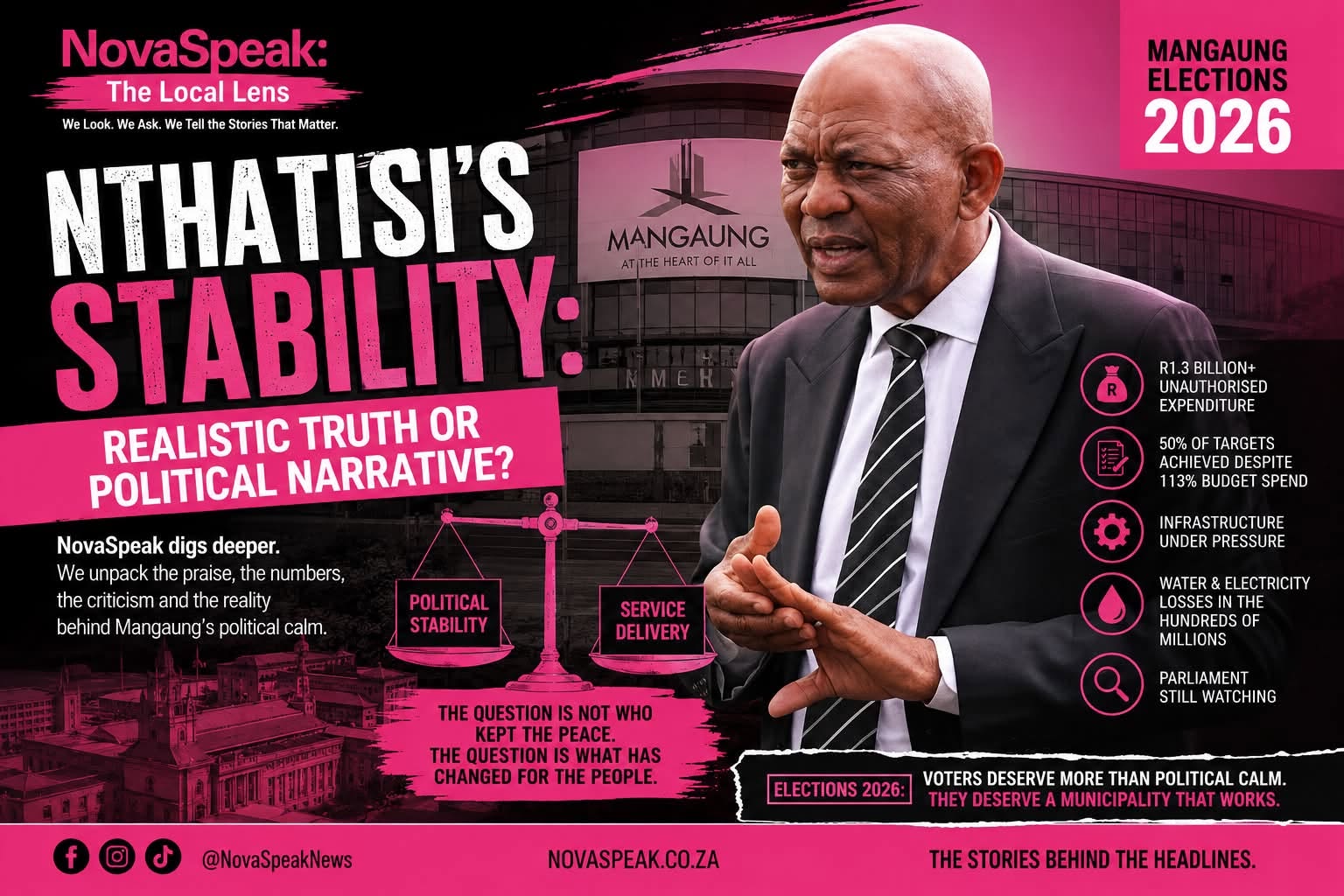
There is a political story about Mangaung that is beginning to take shape ahead of the 2026 local government elections.
It goes something like this, Gregory Nthatisi arrived at a municipality consumed by factional battles, brought a measure of calm to the political environment and, through what has been described as quiet diplomacy and political experience, helped stabilise Mangaung.
It is a compelling political narrative,but there is another question that needs to be asked.
What if what is being described as political stability is actually simply the absence of the spectacular political chaos that preceded it, while the deeper governance problems remain unresolved?
That distinction matters, because Mangaung residents do not experience governance through council-room diplomacy.
They experience it through whether the water runs, whether roads are maintained, whether sewage is dealt with, whether electricity infrastructure works, whether municipal money is protected and whether promises translate into services.
And when the municipality’s own performance records and Parliament’s oversight findings are placed alongside the praise for political stability, the picture becomes considerably more complicated.
THE NUMBERS DON’T SOUND LIKE A STABLE SUCCESS STORY
In May 2026, Parliament’s Standing Committee on Public Accounts (SCOPA) put Mangaung’s leadership under intense scrutiny. The figures presented were difficult to explain away.
Mangaung had spent 113% of its budget while achieving only 50% of its service-delivery targets. The municipality had also been under provincial intervention since January 2020, with the intervention escalated to the national level in April 2022.
A Financial Recovery Plan was approved in September 2023 to help restore the municipality’s finances and governance.
Yet Parliament was told that only 58% of the recovery plan’s activities had been implemented, with Mangaung still described as being in the “rescue phase” after 22 months. (Parliament of South Africa)
That raises an uncomfortable question:
If political stability is the measure of success, what should residents make of the gap between political stability and municipal performance?
MATEBESI’S OWN HISTORY OF COMMENTARY COMPLICATES THE STORY
Professor Sethulego Matebesi, the University of the Free State political analyst quoted in the original article, is certainly entitled to recognise positive qualities in Nthatisi’s leadership.
But his previous public analysis of Mangaung tells a far more complicated story.
In 2022, Matebesi described the metro as embodying characteristics contrary to what should be expected from a democratic state institution. He linked political instability to the collapse of service delivery and warned about deep factionalism within the Free State ANC and in March 2023, when Mangaung was again caught in a leadership vacuum, Matebesi told SABC News that there appeared to be a lack of political will to deal with the municipality’s underlying problems.
He even raised the possibility of dissolving the council, while questioning whether simply recycling political leadership would solve the problem. (SABC News)
His more recent comments may reflect a different assessment of Nthatisi personally, but the historical record is important. Because Mangaung’s problem was never simply that politicians were fighting. As the bigger problem was that political dysfunction translated into institutional dysfunction.
SO HAS THE POLITICAL TEMPERATURE DROPPED?
Perhaps, but that does not automatically mean Mangaung has recovered. The Auditor-General’s findings presented to Parliament in April painted a sobering picture.
Mangaung had accumulated more than R1.3 billion in unauthorised expenditure over three years, while irregular expenditure stood at about R324 million and fruitless and wasteful expenditure at approximately R190 million.
The metro achieved only half of its service-delivery targets despite spending more than its entire budget.
The AG also identified 27 material irregularities, including cases involving estimated financial losses of about R112 million. (Business Day)
There were further concerns around water losses, electricity losses, infrastructure maintenance, overtime expenditure, procurement controls and financial management. The figures do not describe a municipality that has solved its governance crisis.
They describe a municipality still fighting its way out of one and then came SCOPA.
The parliamentary hearing arguably provided the strongest counterpoint to the “Nthatisi has stabilised Mangaung” narrative.
SCOPA chairperson Songezo Zibi criticised the municipality’s response to the Auditor-General’s findings, saying the presentation appeared to “gloss over” the issues instead of directly confronting them.
MPs questioned the municipality about overtime expenditure, weak infrastructure maintenance, staffing structures, Hawks investigations and other governance concerns. (News24)
The issue was therefore not simply whether Mangaung’s political leadership was fighting less. The issue was whether the leadership was producing sufficiently strong governance outcomes and those are two very different tests.
THE OPPOSITION’S VERSION IS EVEN MORE DAMNING
DA Mangaung mayoral candidate Werner Pretorius has taken an entirely different view.
In May, Pretorius described Mangaung’s problems as a failure of political will and leadership, arguing that residents were experiencing the consequences through poor basic service delivery. The DA’s position is obviously politically interested, Pretorius is Nthatisi’s electoral opponent and therefore his assessment should not simply be accepted as neutral analysis.
But it should not be dismissed either.
Political opponents are often among the first people to identify weaknesses that incumbents would prefer to minimise, which in this case, some of the criticism is supported by independent oversight findings. (Democratic Alliance)
SAMWU ALSO RAISED A DIFFERENT RED FLAG
The criticism is not limited to opposition politicians.
In 2025, SA Municipal Workers Union Free State provincial secretary Thabang Tseuoa described Mangaung’s crisis as rooted in systemic governance failures, financial mismanagement and corruption.
At the time, the municipality had spent 111% of its budget while delivering only 45% of expected services. That is an important historical comparison because it shows that the problem cannot simply be reduced to one bad political faction or one former mayor, the weaknesses are institutional and structural.
POLITICAL CALMS IS NOT THE SAME AS GOVERNMENT PERFORMANCE
This is where the debate around Nthatisi becomes interesting, where perhaps Nthatisi really has succeeded in lowering the political temperature inside Mangaung and perhaps his temperament, relationships and political experience have helped prevent the kind of public political warfare that characterised earlier periods.
That deserves acknowledgement.
But political peace is not the final product of local government.
It is supposed to create the environment in which government works.
The real test is what happens after the political fighting stops.
Do finances improve?
Do audit outcomes improve?
Do infrastructure projects get completed?
Does service delivery improve?
Does consequence management happen?
Does the municipality recover money lost through irregular or unauthorised expenditure?
Do residents see measurable improvements in their daily lives?
Those are the questions voters will ultimately have to answer.
THE MUNICIPALITY’S OWN DOCUMENTS PROVIDE ANOTHER WARNING
Mangaung’s current strategic documents themselves acknowledge the challenges.
Its 2025/26 Service Delivery and Budget Implementation Plan identifies institutional capacity, financial health, road maintenance, infrastructure, land access and economic development as major priorities. In other words, even the municipality’s own planning framework recognises that substantial work remains. (Mangaung)
That is hardly evidence of a municipality that has arrived at stability. It is evidence of a municipality still trying to rebuild.
THE REAL ELECTION QUESTION
This is where the 2026 election becomes much bigger than a contest over personalities.
It should not simply be:
“Who kept Mangaung politically stable?”
The more important question is:
“Who can turn political stability into functioning government?”
Because residents cannot drink political stability.
They cannot drive on political stability.
They cannot flush political stability.
They cannot switch on political stability.
They need functioning institutions.
They need accountable leadership.
They need competent administration.
They need their municipality to spend public money legally and effectively.
And they need evidence that the billions passing through the municipality are producing something tangible in their communities. Gregory Nthatisi may deserve credit for surviving Mangaung’s extraordinary political environment and for maintaining a degree of political continuity, but bear in mind that is only one side of the ledger.
The other side contains qualified audit outcomes, massive unauthorised expenditure, service-delivery targets missed, incomplete recovery-plan activities and repeated parliamentary scrutiny.
That means the question is not whether Nthatisi has brought some stability. The question is whether that stability has produced enough transformation in the actual performance of the municipality and right now, the available evidence does not allow anyone to declare victory.
Perhaps the fairest conclusion is this:
Mangaung may be politically quieter than it was — but quieter does not necessarily mean healthier.
And as voters prepare to decide who should lead the metro next, they deserve an election debate based not only on political temperament, but on measurable results.
Because at the end of the day, the strongest form of political stability is not politicians getting along.
It is a municipality that works.
NovaSpeak: The Local Lens
We Look. We Ask. We Tell The Stories That Matter