Politics
FIVE NAMES. ONE CHAIR. BUT WHY DID THE ANC TAKE SO LONG?
Sol Plaatje’s mayoral race raises an uncomfortable question: was the delay strategy — or indecision?
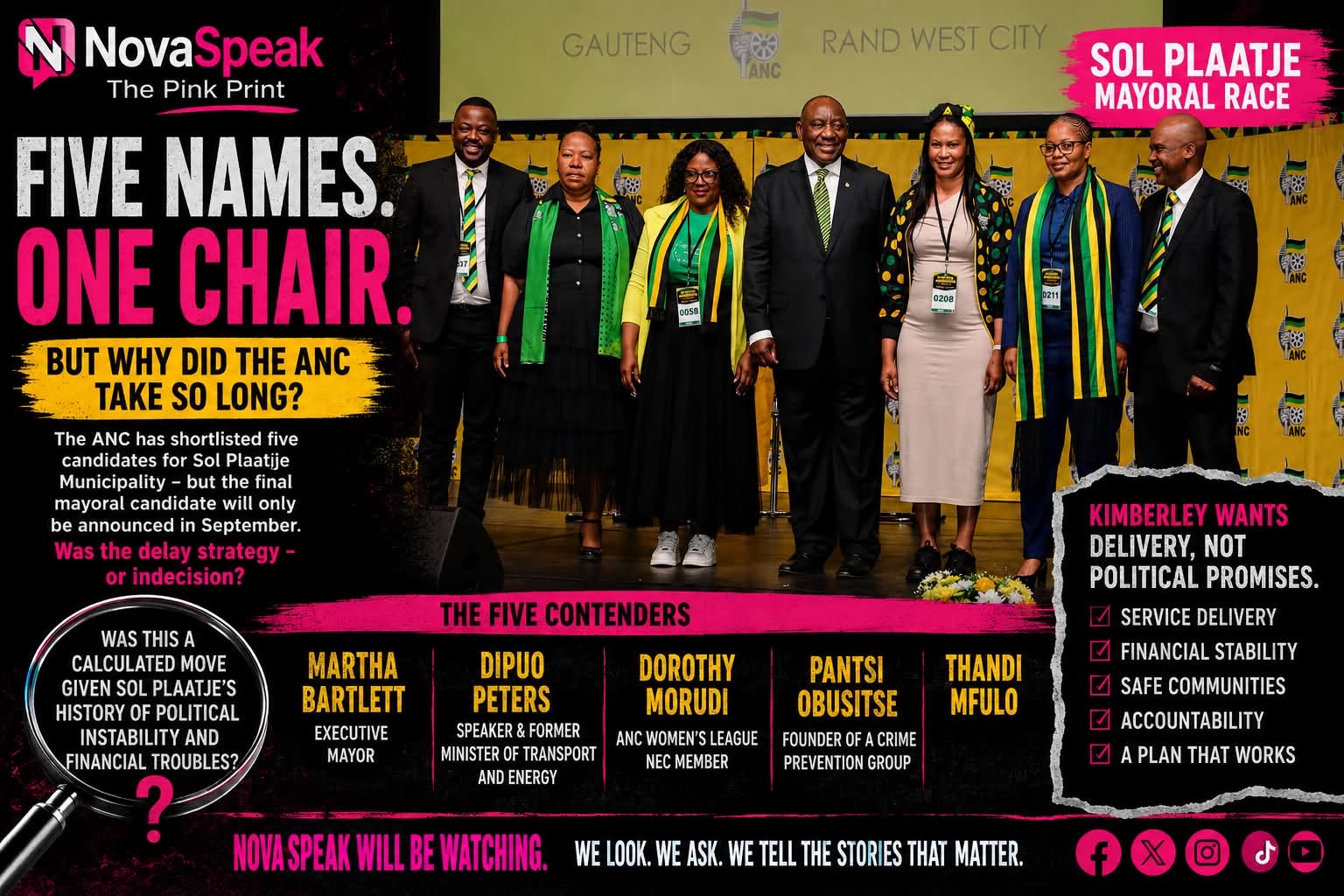
The ANC has finally opened the door to its Sol Plaatje mayoral race, but instead of giving Kimberley one name, the party has given voters five. And perhaps the bigger question is not who made the shortlist, but why did it take this long?
At the Sandton Convention Centre, the ANC presented five potential candidates for Sol Plaatje Municipality: current Executive Mayor Councillor Martha Bartlett, Speaker and former national minister Dipuo Peters, ANC Women’s League NEC member Dorothy Morudi, crime-prevention activist Pantsi Obusitse and Thandi Mfulo. The ANC says the candidates went through a rigorous internal selection process involving nominations, interviews and vetting, while the final mayoral candidate is expected to be announced in September.
But for Sol Plaatje, the timing raises a far more uncomfortable political question: was this really about getting the right candidate or was the ANC buying time to get the politics, right?
NovaSpeak is not suggesting that the ANC deliberately delayed the process to manipulate the outcome. But politically, the delay is difficult to ignore, particularly when viewed against Sol Plaatje’s history. This is not an ordinary municipality. Sol Plaatje has a history of leadership instability, political battles and serious governance concerns. The municipality has experienced repeated changes in political leadership, while the current term has seen the ANC lose and later regain its outright majority.
In 2023, the ANC lost its majority following a by-election and subsequently governed in coalition with GOOD before regaining the seat in 2025. That alone demonstrates that the ANC’s hold over Sol Plaatje cannot simply be taken for granted. More recently, the municipality has faced financial difficulties serious enough to attract calls for intervention. In May 2026, the DA challenged a Section 139(1)(b) intervention, pointing to the municipality’s financial problems and salary-related difficulties.
So, the ANC is not simply selecting a person to occupy a mayoral chair. It is selecting the person who could inherit one of the party’s most politically sensitive municipalities in the Northern Cape and that changes everything. If the process was straightforward, why did the party need so much time to arrive at a shortlist? Was there disagreement inside the organization? Were factional interests being weighed? Was the party assessing which candidate could unite its structures? Was it considering the public reputation of each contender? Or was the ANC deliberately avoiding announcing a candidate too early and exposing internal divisions before the election campaign properly begins?
Those questions matter because Sol Plaatje’s political history makes the mayoral position particularly sensitive. The municipality’s council remains ANC-controlled, but the party’s grip has already been tested. The loss of its majority, the subsequent coalition arrangement and the eventual recovery of that majority all point to a municipality where political certainty cannot simply be assumed.
The five candidates themselves also tell a story.
Bartlett represents continuity. If the ANC ultimately chooses the sitting mayor, it will effectively be saying that the current leadership deserves another opportunity. But that choice would immediately invite scrutiny over the municipality’s performance during her tenure. Has the current administration delivered enough to justify another term, or would retaining Bartlett amount to more of the same?
Peters represents political experience at another level. A former national minister and current Speaker, she brings a political CV that few municipal candidates can match. But experience also creates another question: if experience is the selling point, why has Sol Plaatje continued to struggle with the problems it faces?
Morudi represents senior ANC organizational experience through her position on the ANC Women’s League NEC. Obusitse represents community activism and crime prevention, a potentially powerful message in a city where residents have long demanded safer communities. Mfulo completes a field that places different forms of political, organizational and community experience against one another.
The ANC has therefore not simply produced five names, it has produced five possible political narratives, but Kimberley does not need another political narrative.
It needs delivery.
Residents do not wake up every morning asking which candidate has the strongest ANC résumé. They want functioning infrastructure. They want reliable services. They want a municipality that pays its workers and suppliers. They want roads, electricity, water, sanitation and functioning administration. And they want leadership that accepts responsibility when things go wrong.
That is why the ANC’s claim that the candidates underwent a rigorous process must now be tested beyond the party’s internal structures. What were the measurable criteria? Who performed best? Who has the strongest governance record? Who has the cleanest political and administrative record? Who has demonstrated the ability to manage a municipality under pressure? And, perhaps most importantly, who has a credible plan to rescue Sol Plaatje?
Because whoever wins the ANC’s internal contest will not simply inherit a title, they will inherit the municipality’s problems. Perhaps the ANC did not take so long because it was confused. Perhaps it took so long because Sol Plaatje matters.
The municipality is the Northern Cape’s major urban centre, and the ANC cannot afford to treat its mayoral candidate as an ordinary political appointment. With the 2026 local government elections approaching, every decision now carries electoral consequences.
The party knows that choosing the wrong candidate could deepen existing political divisions. Choosing the right candidate could give it an opportunity to rebuild credibility. And choosing a candidate who cannot deliver could turn every unresolved municipal problem into an opposition campaign weapon.
So perhaps the real story behind the delay is not simply: “Why couldn’t the ANC choose a mayor?”
Perhaps it is: “What was the ANC trying to get right before it dared to choose one?”
For now, five names remain, Martha Bartlett, Dipuo Peters, Dorothy Morudi, Pantsi Obusitse and Thandi Mfulo. One will eventually get the chain, but before that happens, Kimberley deserves to know whether the ANC has selected a mayor for the municipality or selected a politician for the election.
NovaSpeak will be watching.
We Look. We Ask. We Tell The Stories That Matter.