Politics
ANC PROMISES A MUNICIPAL MIRACLE
LIVING IN A DREAM WORLD FILLED WITH IMAGINATION
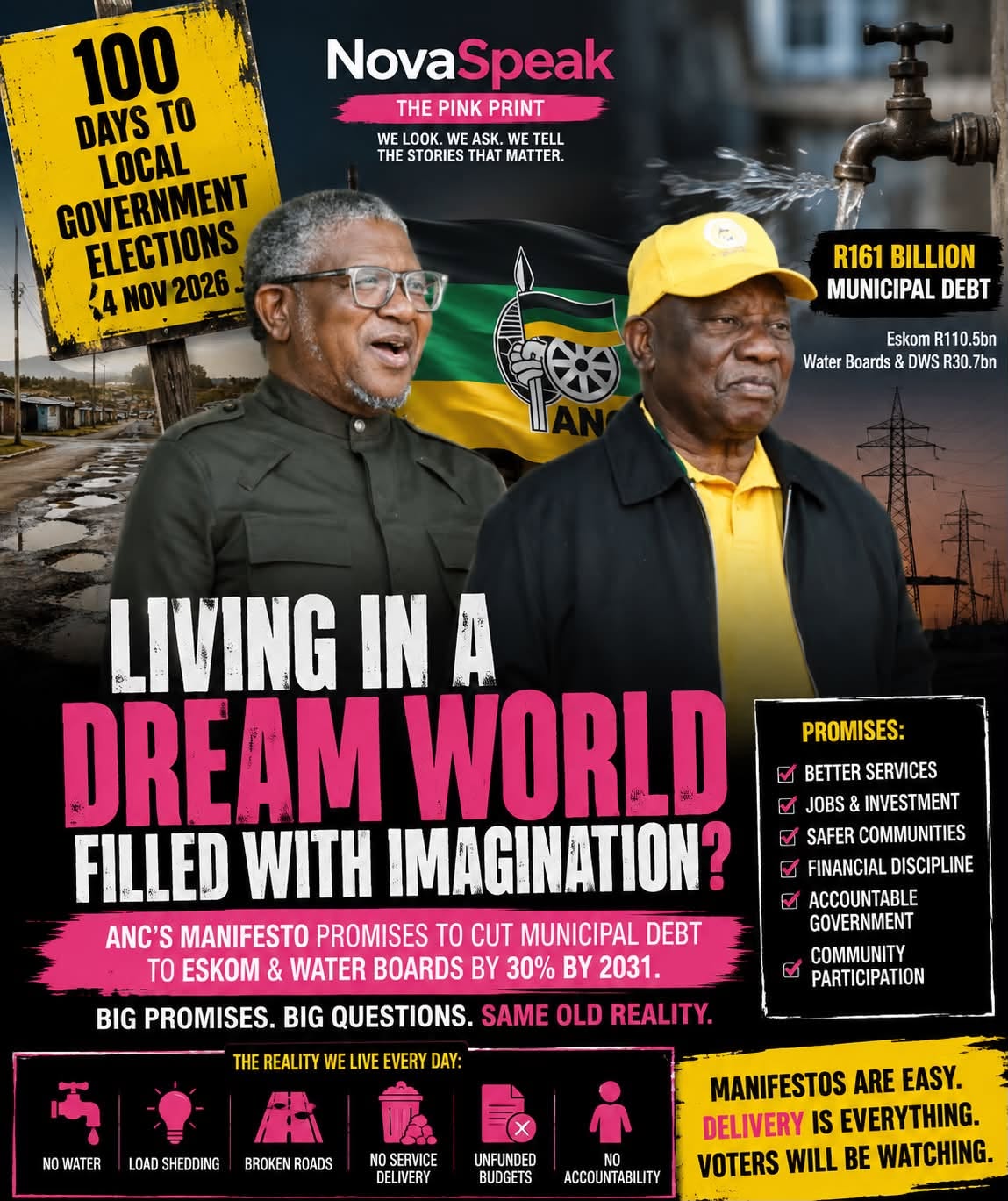
LIVING IN A DREAM WORLD FILLED WITH IMAGINATION:
South Africans have heard the promises before. Fix the municipalities. Restore financial discipline. Deliver reliable services. Eliminate corruption. Improve audit outcomes. Pay suppliers. Repair the infrastructure. Collect the money. Make local government work.
Now the African National Congress is promising it all again — only this time there is a deadline attached.
By 2031, the party says municipal debt owed to Eskom and the country's water authorities should be reduced by at least 30%, while at least half of South Africa's municipalities should achieve clean or unqualified audit outcomes. On paper, it sounds like exactly the kind of municipal future residents should want. Who would object to financially stable municipalities, functioning infrastructure, better audits and government that actually pays its bills?
The difficulty is not imagining that future.
The difficulty is believing it.
Because the ANC is asking South Africans to believe in a municipal transformation while millions of residents are still living with the consequences of municipal failure today. The financial hole confronting local government is not theoretical. According to National Treasury, municipalities owed creditors R160.8 billion at the end of December 2025, with more than R135 billion of that debt outstanding for longer than 90 days. Municipalities owed R87.9 billion to bulk electricity suppliers and another R27.3 billion to bulk water creditors. At the same time, consumers owed municipalities R467.2 billion.
Those numbers tell a story far bigger than municipal balance sheets.
They describe a system in which money is owed at almost every level, where municipalities struggle to collect what residents and businesses owe them while simultaneously accumulating enormous debts to the institutions that keep the lights and taps running. Somewhere between those figures sits the ordinary South African who does not care about the language of accruals, creditors and financial recovery plans. They care about whether the electricity works, whether the water flows, whether sewage stays where it belongs, whether the rubbish is collected and whether the road outside their house is safe to drive on.
That is where the ANC's manifesto meets reality.
For years, residents have stood at dry taps, driven around potholes, watched sewage spill into streets, waited for refuse collection and watched municipal infrastructure deteriorate. They have seen projects launched with political fanfare only for progress to stall. They have entered municipal offices searching for solutions and left with another reference number, another promise or another explanation.
For these residents, better local government is not an ideological concept.
It is the difference between a functioning community and one slowly being forced to fend for itself.
That is why the ANC's latest promises deserve something more than applause. They deserve scrutiny.
The party says it wants stronger financial management, improved revenue collection, modernised billing systems, infrastructure investment and greater accountability. Again, there is little to disagree with. These are the foundations of functioning local government.
But the obvious question is: why are they still promises?
South Africa has spent years producing municipal recovery plans, turnaround strategies, intervention programmes and political commitments. Yet the same failures continue to appear in audit reports, parliamentary hearings, council meetings and community complaints.
So when voters are told that the next five years will be different, they are entitled to ask what has fundamentally changed.
Where is the mechanism that will make this promise different from the promises before it?
Who will be responsible when municipalities miss their targets?
What happens when financial regulations are repeatedly ignored?
What happens when a council adopts an unfunded budget?
What happens when a municipality continues failing to collect revenue?
What happens when suppliers go unpaid while political promises continue to be made?
And perhaps the most important question of all: what happens when 2031 arrives?
Will South Africans receive a transparent national scorecard showing which municipalities reduced their debt, which failed, which targets were achieved and which political and administrative leaders were held responsible for failure?
Or will 2031 simply produce another manifesto explaining why the targets could not be reached?
These are not hostile questions. They are democratic questions.
In fact, the ANC's own electoral history makes them even more important. Its share of the national municipal vote fell from 53.9% in 2016 to 45.59% in 2021, while hung councils became increasingly common. The party is therefore not simply presenting another policy document. It is asking voters who have already expressed dissatisfaction with local government to give it another opportunity to govern.
But another opportunity cannot simply mean another promise.
It must mean another standard.
And that is where the ANC's proposed 30% reduction in municipal debt becomes particularly interesting. Municipal recovery is not impossible. Johannesburg's recent settlement of billions of rand owed to Eskom demonstrates that even enormous municipal debt can be confronted when political and financial solutions are found.
So the question is not whether the target can theoretically be achieved.
It can.
The real question is whether the political will, administrative capacity and discipline exist to achieve it consistently across municipalities that differ dramatically in size, resources, leadership and institutional strength.
Reducing municipal debt is not achieved by writing “30%” into a manifesto.
It requires municipalities to collect legitimate revenue.
It requires accurate billing systems.
It requires residents and businesses to pay legitimate accounts.
It requires political leaders to respect the independence of administration.
It requires competent municipal managers and finance officials.
It requires proper procurement.
It requires consequence management.
It requires councils to stop treating public finances as a political playground.
And above all, it requires accountability that means something when people fail.
That last part may be the hardest.
South Africans have become accustomed to hearing about investigations, task teams, recovery plans and intervention programmes. What they have not always seen is the consequence at the end of the process. Reports are produced. Findings are tabled. Recommendations are made. Meetings are held. Statements are issued.
Then, somehow, the system carries on.
That is why the ANC's promise to improve audit outcomes should not merely be measured by how many municipalities receive a cleaner audit opinion. A clean audit matters, but residents ultimately need to know whether the municipality behind that audit is actually functioning.
A municipality can have impressive paperwork while a community still has a broken sewer system.
A municipality can improve its financial statements while a road remains unrepaired.
A municipality can boast about digital transformation while residents still struggle to get a human being to respond to a service complaint.
The ultimate audit, therefore, is not only the Auditor-General's report.
It is the community itself.
Ask the resident.
Ask the business owner.
Ask the contractor.
Ask the pensioner.
Ask the young person looking for work.
Ask the family waiting for a municipal response.
They will tell you whether government is working.
This is also why the ANC's promises around infrastructure and service delivery cannot be separated from the financial crisis. Roads, water systems, electricity networks, sanitation and refuse collection do not function because politicians announce that they should. They function because municipalities plan, budget, procure, maintain and monitor properly.
When those systems fail, the consequences move quickly from municipal offices into people's homes.
A leaking pipe becomes a water shortage.
A neglected electrical network becomes an outage.
An unpaid contractor becomes an incomplete project.
Poor revenue collection becomes a financial crisis.
A financial crisis becomes deteriorating infrastructure.
And deteriorating infrastructure eventually becomes a crisis of public confidence.
That cycle is what the ANC now says it wants to break.
Fair enough.
But voters are entitled to ask why they should believe the cycle will be broken this time.
The party wants South Africans to look towards 2031.
Voters, however, are looking at 2026.
They are looking at the road outside their homes.
They are looking at their municipal accounts.
They are looking at the water coming — or not coming — from their taps.
They are looking at the state of their neighbourhoods.
They are looking at whether their municipality answers the phone.
They are looking at whether projects are completed.
They are looking at whether public money produces public value.
And, perhaps most importantly, they are looking backwards.
They remember the promises made five years ago.
They remember the promises made before that.
They remember the plans.
They remember the interventions.
They remember the speeches.
They remember being told that things would get better.
That memory matters.
Because an election is not simply a competition between manifestos. It is also a reckoning with performance.
The ANC can promise a municipal miracle. It can present ambitious targets. It can speak about financial recovery, clean audits, infrastructure investment and better services.
But a manifesto cannot erase history.
Only delivery can.
And delivery is not something that happens on a campaign stage. It happens slowly, visibly and repeatedly — in streets, homes, businesses, municipal offices and communities.
That is why NovaSpeak does not dismiss the ANC's promises simply because they come from the ANC. Better municipalities are something every South African should want. Stronger finances matter. Reliable services matter. Clean governance matters. Infrastructure matters.
But good intentions cannot be the end of the conversation.
The country has heard enough about what government intends to do.
Now it needs to know how.
How will the targets be enforced?
How will failures be exposed?
How will officials be held responsible?
How will municipalities be prevented from repeating the same mistakes?
How will residents know whether progress is real?
And what happens when the promises fail?
Those answers matter because residents do not experience government through manifestos.
They experience it through service delivery.
They experience it at the tap.
On the road.
At the electricity box.
Outside the municipal office.
Inside the business.
At the sewage outlet.
At the refuse collection point.
And in the condition of the neighbourhood they call home.
So, to the ANC, NovaSpeak has one simple message:
Dream big. Build better. Promise the miracle if you must.
But this time, don't bring South Africans another dream.
Bring us the receipts.
Show us the targets.
Show us the timelines.
Show us the budgets.
Show us the progress.
Show us who is responsible.
And when something goes wrong, show us who answers for it.
Because South Africa has lived through enough political imagination.
It has heard enough plans for tomorrow while dealing with the failures of today.
The country does not need another beautiful municipal dream.
It needs reality.
NovaSpeak | The Pink Print
We Look. We Ask. We Tell The Stories That Matter.