Opinion
THE PRICE OF POWER: WHAT DOES RAMAPHOSA’S PRESIDENCY MEAN FOR HEIDEDAL?
Analysis inspired by figures and arguments presented by Shaun Schutte
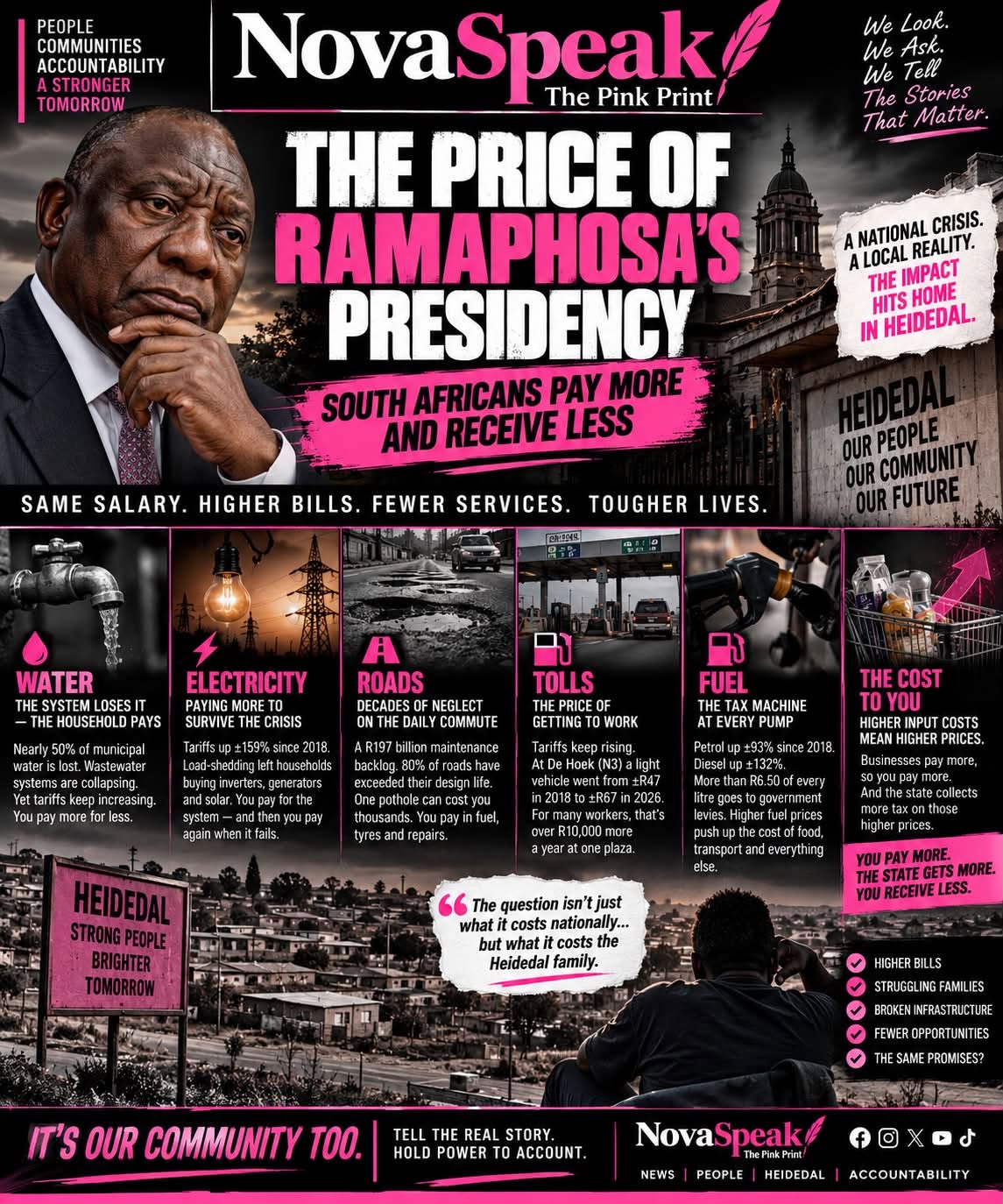
From electricity and petrol to water, roads and the cost of simply getting through the month — the national crisis eventually arrives at the kitchen table in Heidedal.
Politics is often discussed in Pretoria, Parliament and government boardrooms, but the real test of any presidency happens much closer to home — in the kitchen of an ordinary family trying to stretch a salary until the end of the month. That is why an analysis by Shaun Schutte examining the rising cost of living under President Cyril Ramaphosa deserves to be looked at through the eyes of communities such as Heidedal, where the question is not simply whether electricity tariffs increased by a certain percentage, whether petrol went up by a certain number of cents or whether municipalities are struggling with water infrastructure. For an ordinary household, the question is much simpler: how much more does it cost me to live?
Since Ramaphosa became President in 2018, South Africans have experienced a succession of increases across the basic necessities of everyday life. Water, electricity, fuel, transport, roads and municipal services may appear to be separate issues when discussed individually, but to an ordinary household they all come out of the same pocket. A family does not pay for electricity with one salary and petrol with another. The same person who has to keep the lights on may also have to put fuel in the car to get to work, pay municipal charges, buy groceries, maintain a vehicle damaged by deteriorating roads and somehow find money for school expenses. That is where national policy becomes local reality — and Heidedal knows that pocket.
Electricity is perhaps one of the clearest examples. Eskom’s financial and operational problems did not begin with Ramaphosa, and that must be acknowledged, but after more than eight years in the country’s highest office, the question of accountability cannot simply be pushed backwards indefinitely. For years, South Africans endured load-shedding while electricity tariffs continued rising, forcing many households to begin purchasing their own backup electricity in ways that would have been almost unimaginable years ago. Inverters, batteries, solar panels and generators became household considerations, followed by another expense: the fuel required to keep some of those generators running.
For a household in Heidedal, that can mean paying for electricity twice — once through the official system and again to protect the household when that system cannot reliably provide it. Even where the national grid has improved, local electricity failures remain a reality in many communities. So the question is no longer simply whether load-shedding has improved. It is also how much ordinary South Africans spent protecting themselves from an unreliable system.
Then there is water, one of the most basic responsibilities of government. South Africa continues to lose enormous quantities of municipal water through leaks, illegal connections, inaccurate metering and failing infrastructure, while wastewater treatment systems have deteriorated, with hundreds classified as being in critical condition. For communities, however, these problems are not theoretical. A leaking pipe is not merely an infrastructure statistic. A sewage spill is not merely a municipal report. A dry tap is not merely an operational problem. It is someone’s home. When water infrastructure fails, households still carry the financial consequences, which is why Heidedal residents know that service delivery cannot be measured only by what appears in a government report. It has to be measured by whether water comes out of the tap, whether sewage stays in the pipes and whether infrastructure works when residents need it.
The same principle applies to roads. For the person travelling through Heidedal every morning, a pothole is not simply an ugly patch of broken tar. It can mean a damaged tyre, a bent rim, suspension repairs, alignment problems and another unexpected bill. South Africa’s broader road maintenance backlog is enormous, and much of the country’s road infrastructure has passed its intended design life. Again, it would be misleading to suggest that Ramaphosa personally created every pothole — he did not. But after years of ANC national government and more than eight years of Ramaphosa’s presidency, citizens are entitled to ask what has actually been done to reverse the deterioration. When government does not maintain public infrastructure, the private household can eventually become the repair department.
Then there is petrol, perhaps one of the clearest ways the cost-of-living crisis follows people home. For a Heidedal worker driving to Bloemfontein’s industrial areas, businesses, schools, hospitals or surrounding towns, petrol is not necessarily a luxury. It is the cost of getting to work. When fuel prices rise, the consequences do not stop at the petrol station. The delivery truck pays more. The taxi operator pays more. The farmer pays more. The shop pays more. The manufacturer pays more. Eventually, the consumer pays more. The item that costs R20 at the shop does not arrive there by magic; somebody transported it, and somebody paid for the fuel. The fuel price therefore travels through the entire economy, becoming part of food prices, transport costs and household expenses.
This is perhaps the central issue raised by Schutte’s analysis: the South African household increasingly finds itself paying for government systems and then paying privately when those systems fail. Pay for electricity, then buy an inverter. Pay for water, then buy storage when supply becomes unreliable. Pay taxes and fuel levies, then pay for vehicle repairs caused by poor roads. Pay municipal charges, then sometimes pay privately for services that should already be functioning. Pay more for goods because transport costs have increased, and when prices rise, VAT is collected on those higher prices. The cost of failure does not necessarily disappear. It moves — from government to municipalities, from municipalities to businesses, from businesses to households and eventually to the person standing at the till counting the last few notes in their wallet.
But is all of this Ramaphosa’s fault? That is where the conversation needs to remain honest. It would be intellectually lazy to suggest that Cyril Ramaphosa personally caused every pothole, every electricity increase, every water leak or every movement in the petrol price. International oil prices matter. The rand matters. Municipal governments matter. Provincial governments matter. Historical infrastructure failures matter. Global economic conditions matter. Many of South Africa’s problems existed long before 2018.
Accountability, however, does not mean claiming that one person created every problem. Accountability means asking what happened while you were responsible for fixing them. Ramaphosa inherited serious problems, but he also inherited the authority to change them. That is the standard against which his presidency should ultimately be judged.
And that is precisely why the national debate has everything to do with Heidedal. The community is not isolated from South Africa’s national economy. Political decisions made in Pretoria eventually arrive in Heidedal as a municipal bill, a petrol price, a grocery receipt, a taxi fare, a damaged tyre or an electricity account. National politics may feel distant when discussed in Parliament, but its consequences become immediate when a household has to decide which bill can be paid and which one must wait.
As the 2026 local government elections approach, political parties will increasingly arrive in communities, knock on doors, hold meetings, put up posters and make promises. Residents will listen, but they should also ask what those promises mean in practical terms for their households. What does your politics actually mean for my electricity bill? Will my water work? Will my roads be maintained? Can I afford to travel to work? Can my small business survive rising costs? Can my children find opportunities? And when something goes wrong, who takes responsibility?
Those questions should not belong to one political party. They should belong to every political party asking Heidedal for its vote. A vote is not a blank cheque. Residents should ask what happened before the election, what happened after the previous election, what was promised, what was delivered, who benefited, who was forgotten and who will still be standing in the community when the posters have been removed. Heidedal’s problems did not begin when the election calendar was announced, and they will not disappear when election day is over.
The cost of living is not a political slogan. The electricity bill is real. The water bill is real. The petrol price is real. The pothole is real. The grocery receipt is real. And for many families, the pressure is becoming very real. Perhaps that is the biggest lesson from Shaun Schutte’s analysis: instead of looking at every increase as an isolated event, South Africans should consider the combined cost of living and what happens when multiple pressures accumulate in the same household. One R100 increase might be manageable. Another R100 might still be manageable. Another R100 might be absorbed. But eventually, all those R100s come together — and somebody has to pay.
In Heidedal, that somebody is often an ordinary family already trying to survive.
So perhaps the question should not simply be whether Ramaphosa is responsible for everything. He is not. The more important question is whether, after more than eight years in power, the government led by Cyril Ramaphosa has made ordinary South Africans’ lives more affordable, more secure and more functional — or whether citizens have increasingly been forced to pay more to receive less.
That is not an ANC question. It is not a DA question. It is not a VF+ question. It is not a PA question.
It is a Heidedal question.
And before residents cast their votes in 2026, it is a question every political party asking for their support should be prepared to answer.
NovaSpeak | The Pink Print
We Look. We Ask. We Tell The Stories That Matter.