Health
CATTLE ON BLOEMFONTEIN’S ROADS
THE HERD IS VISIBLE — BUT WHO IS WATCHING THE DISEASE?
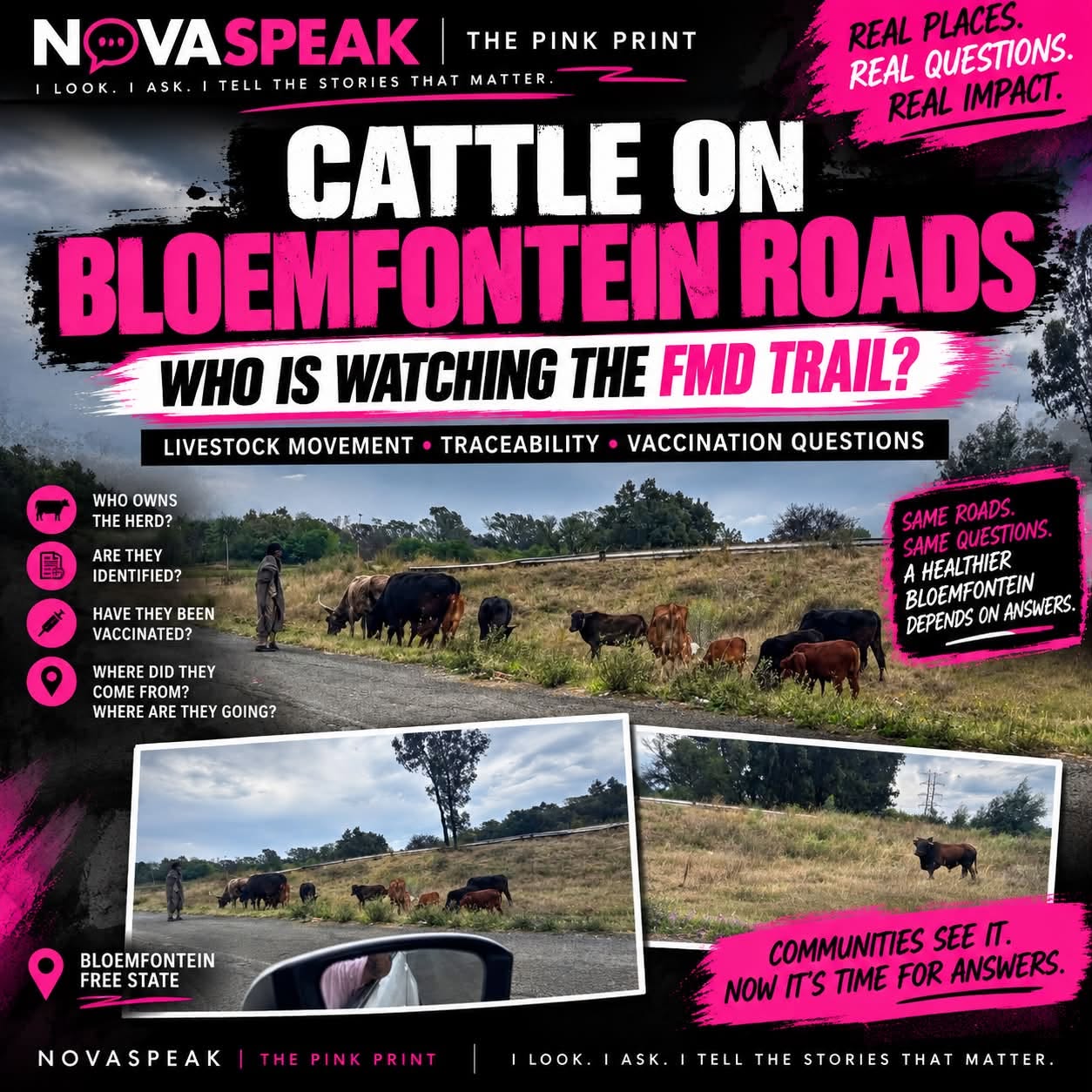
BLOEMFONTEIN — A herd of cattle grazing and being walked alongside a public road in Bloemfontein has raised a question that extends well beyond whether livestock should be wandering through an urban environment: in a province still dealing with active foot-and-mouth disease, who is watching the movement of these animals?
Photographs taken by NovaSpeak show a sizeable herd grazing immediately alongside a public road, with a person apparently herding the cattle. The images do not show that these particular animals are infected with foot-and-mouth disease, nor can their vaccination status be established simply by looking at them. But in a province where FMD remains active, the sight of livestock moving through a populated environment inevitably raises questions about ownership, identification, vaccination, traceability and movement control.
The latest figures from the Free State Department of Agriculture show that the province's FMD problem is far from over. As of 20 September 2026, the province had recorded 798 confirmed cases, of which 634 had been resolved while 164 remained active and under quarantine. Two new clinically confirmed cases were recorded in the Bultfontein and Welkom State Veterinary areas, while more than one million cattle in the Free State had been vaccinated as part of the national FMD control strategy.
Bloemfontein itself has also featured in the provincial response, with earlier updates recording clinically confirmed cases in the Bloemfontein State Veterinary area alongside cases in Bethlehem, Welkom, Bultfontein, Fauresmith and Boshof. By 4 September, the province had recorded 795 cases, with 191 still active and under quarantine.
That context changes how an otherwise ordinary sight on a Bloemfontein roadside should be viewed.
The cattle photographed by NovaSpeak are not evidence of an outbreak.
They are evidence of something else: livestock moving in a province where authorities are trying to control a disease that depends heavily on knowing where animals are, where they have been and where they are going.
That is where traceability becomes critical.
South Africa's FMD control framework requires animals participating in the relevant traceability system to carry permanent identification, with cattle identified through unique ear tags. Identification information is recorded within the owner's traceability system, while vaccination status is linked to an animal's vaccination history. Government has repeatedly emphasised that vaccination cannot operate in isolation and must be supported by surveillance, biosecurity, traceability and movement controls.
So when cattle are seen being herded along a public road in Bloemfontein, the important question is not whether the animals look healthy.
It is whether they can be traced.
Who owns them?
Where did they come from?
Where are they going?
Are they individually identified?
Are they part of a communal or commonage herd?
Have they been vaccinated?
And are their movements known to the relevant animal-health authorities?
Those questions are not accusations against the person pictured with the cattle. There is nothing in the photographs that establishes that the owner or herder has breached a disease-control requirement.
But a functioning traceability system should be capable of answering those questions.
That is precisely the purpose of traceability: to make it possible to establish where livestock are, identify their ownership and track movements when disease threatens.
The importance of that system has already been highlighted at national level.
In May, Parliament's Portfolio Committee on Agriculture raised concerns about weaknesses in the implementation of livestock traceability during the FMD response, warning that gaps in traceability and coordination were undermining containment efforts. Committee members also raised concerns about shortages of ear tags, equipment, vehicles and animal-health personnel, while stressing that vaccination alone would not contain the disease without effective movement controls and traceability.
The scale of the vaccination campaign demonstrates that government is not ignoring the crisis. In June, national government announced that the Free State had passed the one-million-animal vaccination milestone, while more than 5.4 million cattle had been vaccinated nationally at that point.
But the continued appearance of new cases makes one thing clear: vaccination cannot be the only line of defence.
An animal being vaccinated does not make it irrelevant to surveillance.
An animal being healthy today does not eliminate the need to know where it came from or where it is going.
And a vaccination programme cannot compensate for weak movement controls if livestock continue moving through the system without adequate traceability.
That is why the cattle photographed on the Bloemfontein roadside matter.
Not because NovaSpeak can determine from a photograph whether they are infected.
We cannot.
Not because their owner can be accused of wrongdoing on the basis of an image.
They cannot.
They matter because the sighting provides an opportunity to examine whether the systems designed to protect South Africa's livestock sector are functioning at ground level.
Because disease control does not happen only in laboratories, veterinary offices or government reports.
It happens wherever animals move.
It happens where herds mix.
It happens at farms, commonages, transport points and along the routes between them.
And it depends on people knowing where livestock are and being able to establish where those animals have been.
That raises questions for the authorities responsible for animal health in and around Mangaung.
How many cattle in the area have been vaccinated?
How many are registered on the applicable traceability system?
Are cattle moving through urban and peri-urban areas subject to specific movement controls?
Who monitors livestock being moved along public roads?
What responsibility rests with owners and herders?
And when cattle are found grazing alongside public roads, which authority is responsible for determining whether their movement is lawful and whether the animals are appropriately identified and accounted for?
These are not questions intended to create panic.
They are questions about whether a system designed to contain a highly contagious animal disease is visible where it matters most — on the ground.
The Free State has already experienced the consequences of FMD. Quarantine measures have been imposed. Vaccination campaigns have been expanded. Surveillance has increased. Hundreds of cases have been resolved, but the latest provincial figures show that 164 cases remained active and under quarantine as of 20 September.
That means the disease-control effort is still ongoing.
And when the province is still recording active cases, every part of the control chain matters.
The cattle on the roadside may be perfectly healthy.
They may be properly identified.
They may be vaccinated.
Their movements may be entirely legitimate and known to the relevant authorities.
But residents should not have to guess.
The public should be able to trust that when livestock move through communities during an active animal-disease response, there are systems capable of identifying them, tracking their movements and intervening where necessary.
Because the fight against foot-and-mouth disease is not won by vaccination figures alone.
It is not won by regulations sitting in government files.
It is not won by statistics appearing in departmental reports.
It is won in the places where livestock actually move.
On farms.
On commonages.
Along roads.
Through communities.
And sometimes, in plain sight, beside a Bloemfontein road.
The herd is visible.
The bigger question is whether the system responsible for protecting the province's livestock is watching just as closely.
NovaSpeak asks: When cattle are moved through Bloemfontein during an active FMD response, can authorities trace them, verify their status and account for where they are going?
NovaSpeak | The Pink Print
We Look. We Ask. We Tell The Stories That Matter.