Opinion
“If that person failed you, you fix it with your vote”: Werner challenges Heidedal’s youth
Werner challenges Heidedal’s youth
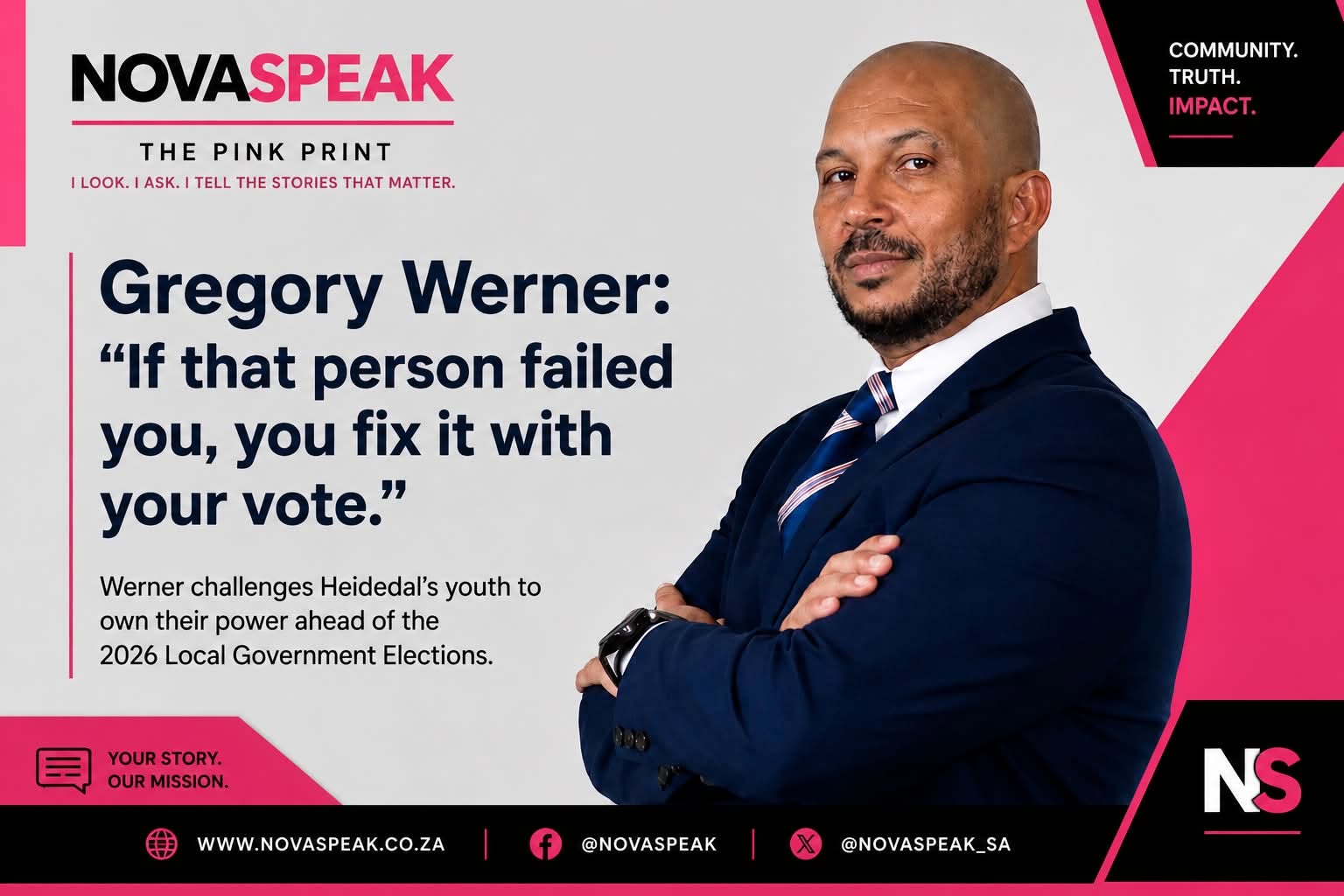
“That is where it matters, where you put a person in power — and if that person failed you, you fix it with your vote.”
That was the blunt message from Gregory Werner when NovaSpeak asked him a question that lingered over a recent voter-education event in Heidedal: where were the young people? The Norman Doubell Hall was packed, but the faces filling the seats appeared to tell their own story. Older residents made up a significant portion of the audience at an event intended to educate the community about the voting process, the importance of participation and the approaching 2026 Local Government Elections. For Werner, the absence of Heidedal’s younger generation was not something to simply overlook. It was a warning.
The event, hosted by Mangaung Metropolitan Municipality in partnership with the Independent Electoral Commission, was designed to bring voter education directly into the community — explaining how voting works, what happens inside a voting station and why citizens should exercise their democratic right. But as Werner looked across the room, another question emerged: if the people who will live longest with the consequences of today’s political decisions are not showing up, who is speaking for them?
Werner believes there may be a practical explanation for why so many older residents attended. He said the South African Social Security Agency and Home Affairs had allegedly been invited to the event, and their expected presence may have attracted an older demographic because those institutions often deal directly with older residents and people requiring identity-document or social-grant services. However, Werner said neither SASSA nor Home Affairs ultimately attended.
For him, however, the bigger issue lies elsewhere. Young people appear to be losing their appetite for politics. And that, he believes, should concern everyone.
Werner suggested that younger people are increasingly consumed by the pressures of everyday life — unemployment, making a living, family responsibilities and the day-to-day struggle to survive — leaving little appetite for political meetings or voter-education events. But there is another possibility: perhaps some young people simply no longer believe politics can change their circumstances.
Perhaps they have watched promises come and go. Perhaps they have seen political campaigns arrive with music, posters and speeches, only for the same problems to remain once the votes have been counted. Perhaps they have become tired. And perhaps that is exactly why they need to vote.
Because disengagement does not punish politicians nearly as much as it can punish the communities that stop participating.
Werner’s message was therefore not a plea for young people to become political activists. It was much simpler: Use the vote.
He said there has been an encouraging increase in interest from younger people in politics in recent days, but that interest needs to translate into action when voters eventually stand before the ballot box.
For Werner, the frustration many residents express about government and political leadership must eventually find its way into the voting booth.
“You can complain until you are blue in the face. It will not help,” he said.
His argument is uncomfortable because it places responsibility directly in the hands of the voter. If a councillor has failed you, vote differently. If a political party has failed your community, vote differently. If promises were made and never delivered, remember that when you stand in front of the ballot paper.
If your street remains neglected, your community remains without adequate services and your concerns continue to be ignored, the vote gives you a mechanism to respond.
“It is only by fixing or by using your vote that you can bring the change that you desire,” Werner said.
And that message should resonate particularly strongly in Heidedal.
This is a community that knows what political decisions look like when they become real life. It knows the frustration of service-delivery problems. It knows the anxiety around housing. It knows what happens when young people struggle to find opportunities. It knows what happens when communities feel unheard.
But none of those problems can be changed by complaining alone.
A WhatsApp message cannot replace a ballot. A Facebook post cannot replace a ballot. A TikTok video cannot replace a ballot. A political argument outside a voting station cannot replace a ballot. And staying at home cannot change who wins the ward.
That is the uncomfortable truth Werner is placing before Heidedal’s youth.
The generation most comfortable using social media to express political opinions must also become comfortable using the democratic mechanism that can change who holds political power.
Young people do not have to agree with the ANC. They do not have to agree with the DA. They do not have to agree with any political party. They do not even have to like politics.
But if they are eligible voters, they have the power to decide who gets entrusted with public office.
And if the person they voted for fails them, they have the power to remove that person at the next election.
That is democracy.
That is accountability.
And that is why Werner’s statement cuts deeper than a conventional call to “go vote”.
“That is where it matters, where you put a person in power — and if that person failed you, you fix it with your vote.”
There is another important lesson in that statement.
Voting does not mean endorsing everything a political party stands for. It means exercising judgement. It means asking questions, looking at the record, deciding whether promises were fulfilled and considering what happened to your community during the previous term.
It means understanding that political power is temporary and that elected representatives ultimately answer to the people who put them there.
For young voters, particularly first-time voters, this may be the most important part of the conversation.
Your vote is not a favour to a politician.
It is not a reward for attending a rally.
It is not something you owe a political party because your parents voted for it.
It is yours.
And once you understand that, the ballot box becomes much more powerful.
The elderly residents who filled Norman Doubell Hall demonstrated something that should not be lost on the younger generation: they showed up. They listened. They engaged.
Now the challenge is for Heidedal’s youth to do the same.
Because the future being decided at the ballot box belongs largely to them.
The jobs.
The housing.
The transport.
The safety.
The education system.
The opportunities.
The municipal services.
The neighbourhoods where they will raise their own children.
Those decisions will outlive the political slogans of 2026.
So perhaps the real question is no longer simply:
“Why are young people not voting?”
Perhaps the question Heidedal’s youth should ask themselves is:
“What happens to my community if I don’t?”
Because politicians will still be elected.
Budgets will still be passed.
Councillors will still take office.
Municipal decisions will still be made.
The only difference is that if you stay away from the ballot box, someone else makes the decision for you.
And when that decision turns out badly, complaining afterwards becomes much easier than changing it.
Werner’s message is therefore not just about voting.
It is about ownership.
It is about refusing to surrender your voice.
It is about understanding that democracy is not something older generations fought for so that younger generations could simply watch from the sidelines.
They fought for the right to choose.
And now that choice belongs to every eligible voter.
“You can use your vote to fix the mess that we are experiencing currently,” Werner said.
For Heidedal’s youth, that may be the challenge worth remembering when the November 2026 Local Government Elections arrive.
Don’t just complain about the mess.
Don’t just post about it.
Don’t just talk about it at the taxi rank, at work, at school, on WhatsApp or around the braai.
Go and vote.
Because the person sitting in power tomorrow will be there because somebody put them there.
And if they fail you, Werner’s message is brutally simple:
You fix it with your vote.
NovaSpeak: The Pink Print
We Look. We Ask. We Tell The Stories That Matter.